US Treasury yields edged lower Monday as a drop in oil prices cooled inflation fears, but the bigger FX driver remains the widening and narrowing of rate differentials across the US, Japan and Europe.
US Dollar Index at 99.8 as Treasury yields ease

That matters because currency traders are still trading the yield spread first and the news flow second. When Treasury yields ease, the dollar tends to lose some support against low-yielding peers; when global yields jump in the wrong place — as they did in Japan after a weak 10-year government bond auction — the resulting volatility can overwhelm any single headline.
Sentiment IndicatorsⓘProprietary · adalytica.com · August 5, 2026
This is a snapshot — live sentiment, awareness and momentum for 130+ markets update continuously in the dashboard.Open AlphaPulse

The benchmark 10-year Treasury yield was forecast at 4.76% on Aug. 4, up from 4.70% on Aug. 3 and 4.75% on July 31, underscoring how sensitive the market remains to even small moves in long-dated US borrowing costs. The 2-year yield was seen at 4.26%, leaving the 10-year minus 2-year spread near 43 basis points, a steepening that typically supports expectations of easier policy down the road and can soften the dollar if it persists.
That helps explain why the dollar’s reaction has been uneven. The dollar index has eased to about 99.8, while USD/JPY is still near 157.5, a level that keeps Japanese authorities and global carry traders on alert. EUR/USD remains around 1.15, showing that the euro is not getting much lift even as US yields drift lower, in part because Europe is also grappling with its own growth and rate outlook.
Technical readings also point to a market that is stretched rather than trending cleanly. The dollar index is trading below its 50-day moving average, while USD/JPY is sitting above its 200-day moving average but with a very weak 14-day RSI, suggesting recent momentum has faded even though the pair remains elevated. In EUR/USD, the 50-day and 200-day moving averages are clustered near 1.15 to 1.16, reinforcing how range-bound the pair has been.
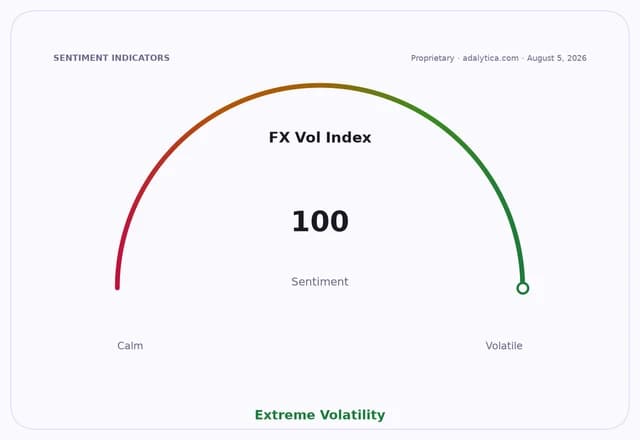
The broader message for investors is that FX is now acting less like a headline tape and more like a relative-value market tied to bond yields, central-bank credibility and volatility itself. Adalytica’s FX volatility trading signals and US dollar trade signals are both flashing extreme greed, a sign that positioning is crowded and short-term swings may be amplified.
That leaves traders focused on the next catalyst rather than the latest headline: more Treasury moves, Japan bond-market stress, oil prices and any fresh shift in Federal Reserve communication. Until those drivers settle, bond yields — not slogans — are likely to keep setting the tone for currencies.
| Entity | Gains | Losses |
|---|---|---|
| US Treasury bulls | ▲Lower yields, higher bond demand | ▼Yield-chasing dollar longs |
| Dollar bears | ▲Softer rate support for USD | ▼Crowded USD positions |
| Yen buyers | ▲JGB stress boosts yen-haven demand | ▼Carry traders funding in yen |
| Euro FX traders | ▲Narrower US yield premium | ▼Range-bound EUR/USD upside |




