US house-price growth is losing momentum as higher borrowing costs and a softer housing market weigh on demand, with the latest national index showing prices rising just 0.64% in May to 335.104 and the next month forecast at 337.1537, up 0.61%.
US House Prices Rise 0.64% in May

That marks a sharp slowdown from the 50.9% jump recorded in June 2022 and from the 2.57% gain seen a year earlier in June 2025. The trend matters because housing is one of the economy’s biggest rate-sensitive sectors, and weaker price appreciation can quickly spill into consumer confidence, construction activity and mortgage lending.
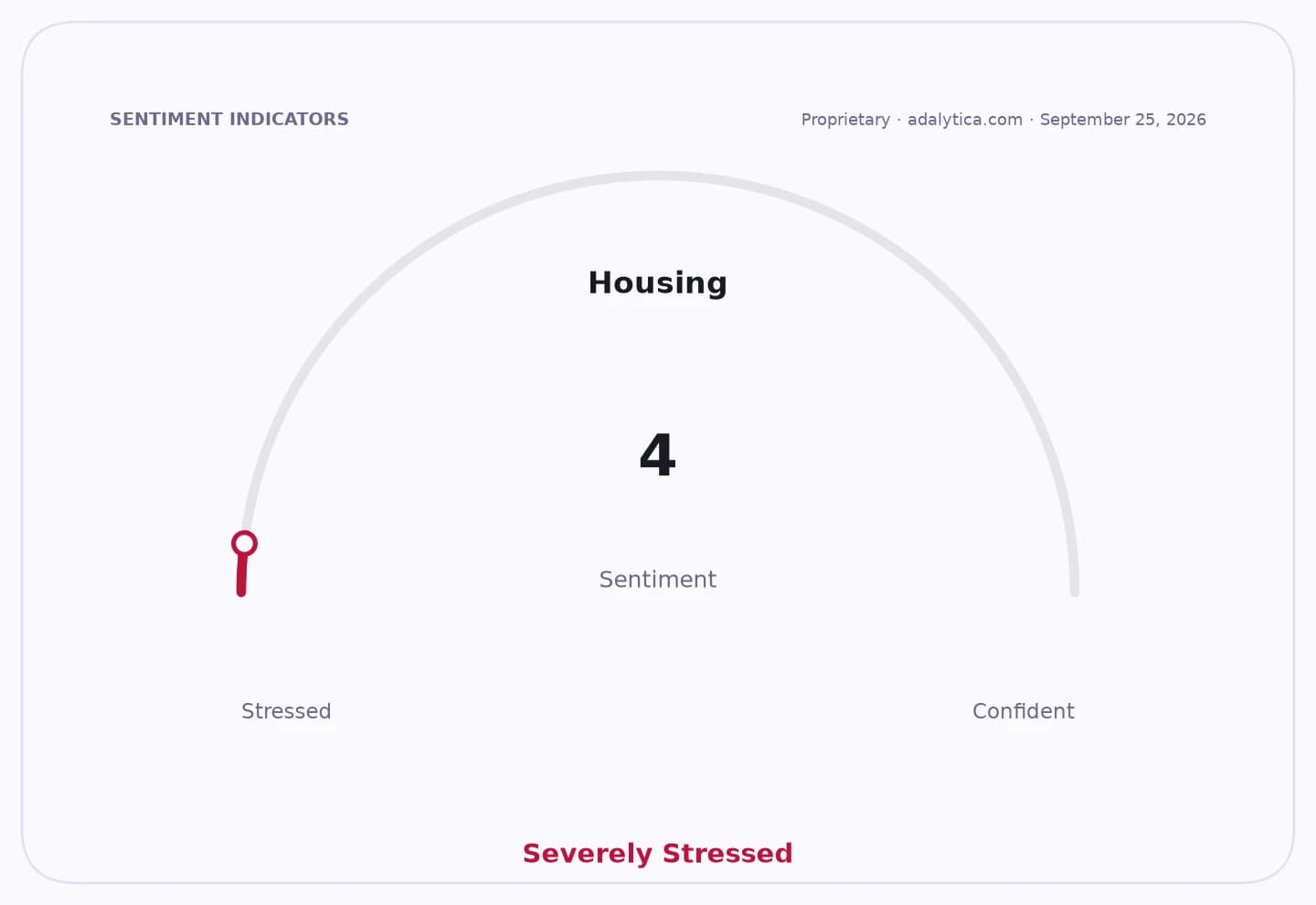
Sentiment IndicatorsⓘProprietary · adalytica.com · August 2, 2026
This is a snapshot — live sentiment, awareness and momentum for 130+ markets update continuously in the dashboard.Open AlphaPulse
The slowdown is showing up across related markets. The iShares U.S. Home Construction ETF, ITB, fell to $94.34 on July 31 from $100.33 three days earlier, while the SPDR S&P Homebuilders ETF, XHB, dropped to $103.69 from $110.80 over the same stretch. Both funds are now trading below their 50-day moving averages, a conventional technical signal that points to fading short-term momentum.
Treasury yields are adding to the pressure. The 10-year yield is around 4.66% to 4.68%, keeping mortgage financing expensive even as the unemployment rate holds at 4.2% and the labor market remains intact. That combination tends to cool buying power without delivering the kind of distress that would stabilize prices quickly.
The strain is also showing in company filings. Lennar said it has been using more sales incentives to price to market, while KB Home reported lower housing revenue and shrinking backlog in several regions. Zillow has also flagged continued uncertainty around the housing market, interest rates and inflation in its latest filing.
For investors, the message is that the housing slowdown is no longer isolated to a few overheated coastal markets or luxury properties. A broader deceleration could keep pressure on homebuilders, mortgage originators and housing-related ETFs even as bond traders position for slower growth.
The next catalyst is fresh inflation and rate data, which will help determine whether falling house-price momentum turns into a more durable downturn or just a pause in a still-overvalued market.
| Entity | Gains | Losses |
|---|---|---|
| Homebuyers | ▲Better affordability | ▼Less leverage for bidding |
| Homebuilders | ▲Easier pricing discipline | ▼Lower margins, softer demand |
| Mortgage lenders | ▲More refi sensitivity if rates ease | ▼Fewer originations at high rates |
| Homebuilder ETFs (ITB, XHB) | ▲Possible rebound if yields fall | ▼Near-term technical weakness |