Inflation is forcing American households to lean harder on credit, and that is the real economic warning sign behind the latest record in household debt.
U.S. household debt rises as inflation stays high

The combination is toxic for consumer spending: prices remain elevated, wages are no longer stretching as far, and borrowing is filling the gap. Consumer price inflation is still running above the Federal Reserve’s comfort zone, with the CPI at 332.813 in July and forecast to edge up again to 333.9723 in August, while disposable personal income climbed to 23,642.22 in April but is projected to rise only modestly to 23,836.43 by July. That mismatch leaves households reliant on credit cards and other revolving debt just to maintain everyday consumption.
Sentiment IndicatorsⓘProprietary · adalytica.com · September 5, 2026
This is a snapshot — live sentiment, awareness and momentum for 130+ markets update continuously in the dashboard.Open AlphaPulse
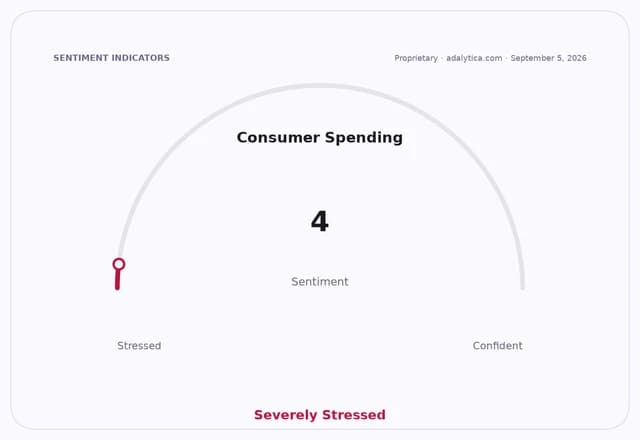
For investors, that matters because the consumer is still the backbone of U.S. growth. When inflation outpaces income, the first-order effect is weaker discretionary demand, and the second-order effect is rising delinquencies as balances compound. Adalytica’s Consumer Spending Sentiment gauge is in “Extreme Fear” at 4, while Credit Card Usage Sentiment sits at “Extreme Greed” at 89, a split that captures the tension in the system: households are anxious, but they are still borrowing heavily to keep spending. That is not a stable mix for retailers, lenders or the broader economy.
The market is already starting to sort winners from losers. Financials, as measured by the XLF ETF, have pushed above both their 50-day and 200-day moving averages, suggesting investors are still favoring large banks and diversified lenders, but the more rate-sensitive consumer complex remains under pressure. The XLY consumer discretionary ETF has lagged, with its price recently sitting below both its 50-day and 200-day moving averages, a sign that the market is discounting weaker household purchasing power ahead. Regional banks, tracked by KRE, have also lost momentum after a strong summer run, underscoring how quickly credit conditions can tighten if borrowers continue to strain.
That is why the record debt load matters beyond the headline. It is not just a statistical milestone; it is a transfer of stress from the inflation shock into the credit system. The longer households rely on cards and other short-term borrowing to bridge the cost-of-living gap, the more earnings risk shifts toward lenders, payment networks, discount retailers and any company exposed to consumer balance-sheet health.
Our view is that the market underestimates how long this squeeze can last. If inflation cools only gradually and income growth stays tepid, consumer spending will keep leaning on debt rather than savings, which supports near-term sales but raises the risk of a later snapback in delinquencies. That makes select lenders and payment processors attractive only if they can price for rising credit risk, while consumer discretionary names remain vulnerable to margin pressure and weaker traffic. In this setup, investors should favor balance-sheet strength, recurring-fee models and businesses that profit from transaction volume rather than fragile household balance sheets.
| Entity | Gains | Losses |
|---|---|---|
| Credit card lenders | ▲Higher interest income | ▼Rising delinquencies |
| Discount retailers | ▲Trading-down traffic | ▼Margin pressure |
| Consumer discretionary stocks | ▲Short-term spending hold-up | ▼Demand slowdown |
| Households | ▲Access to liquidity | ▼Balance-sheet strain |