The global economy is moving into a new inflationary phase, with JPMorgan’s market read reinforced by a firming U.S. dollar, higher Treasury yields and still-sticky consumer prices that point to less room for central banks to ease.
U.S. Inflation Watch Ahead of July CPI, 10-Year Yield at 4.68%

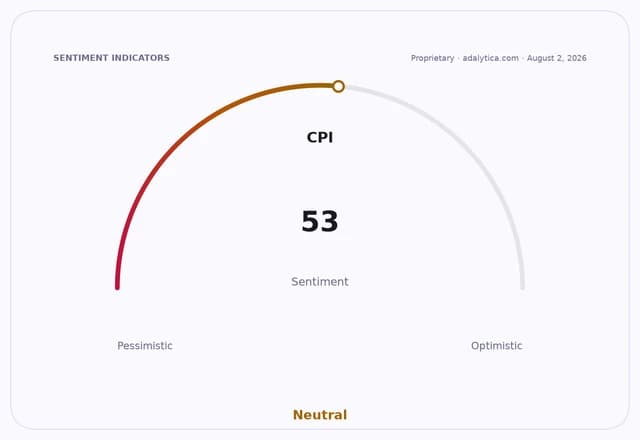
That matters because inflation is once again shaping the cost of capital, real returns and policy flexibility just as investors had begun to price in a softer landing. The U.S. consumer price index is forecast to rise 0.9% in July after a 0.4% drop in June, while core CPI is expected to climb 0.3%, underscoring that price pressures are not fading evenly across the economy.
Sentiment IndicatorsⓘProprietary · adalytica.com · August 2, 2026
This is a snapshot — live sentiment, awareness and momentum for 130+ markets update continuously in the dashboard.Open AlphaPulse
The longer-run numbers show how far inflation has already moved. Headline CPI has climbed to 332.568 in June from 237.336 in early 2016, while core CPI has reached 336.065 from 265.412 in May 2020, leaving the Fed with inflation still above its comfort zone even before any new energy shock. JPMorgan’s thesis of a renewed inflationary era fits a backdrop where supply-side constraints, geopolitics and commodity volatility are reasserting themselves.
Markets are already reflecting that shift. The 10-year Treasury yield has pushed back to 4.68%, up sharply from 0.73% in March 2020, while the U.S. dollar is flashing extreme-greed readings in Adalytica’s trade signals, suggesting investors are crowding into the currency as a hedge against tighter financial conditions and global stress. Treasury bonds, meanwhile, show extremely elevated awareness in Adalytica’s gauge, a sign that inflation and rates remain the dominant macro trade.
CPIAUCSL vs CPILFESL — macro contextadalytica.com
Explore this data interactively — full history, time series and cross-market comparisons.Open AlphaPulse
Equities are responding in more nuanced fashion. JPMorgan shares rose to $351.79 on July 31, above both its 50-day moving average of $326.83 and 200-day moving average of $309.30, while the RSI at 64.7 points to strong but not overheated momentum. Cboe Global Markets also jumped to $310.23, helped by the renewed volatility and rates backdrop that tends to boost derivatives activity and trading volumes.
For investors, the key implication is that the old playbook of falling inflation, lower yields and multiple expansion may be less reliable. A stickier inflation regime would support financials and trading venues that benefit from wider rate spreads and more market churn, but it would pressure duration assets, rate-sensitive sectors and borrowers facing higher funding costs.
The next catalyst is the July CPI report and the Fed’s reaction function. A hotter-than-expected print would likely keep Treasury yields elevated, strengthen the dollar and extend the rotation toward inflation hedges, while a softer reading could temporarily ease pressure but would not by itself reverse the broader re-pricing of inflation risk.
| Entity | Gains | Losses |
|---|---|---|
| JPMorgan, Cboe | ▲Higher trading and rate income | ▼Softer market volatility |
| U.S. dollar | ▲Safe-haven demand | ▼Foreign borrowers, exporters |
| Treasury bond holders | ▲Short-term hedge demand | ▼Price losses from higher yields |
| Rate-sensitive equities | ▲Lower funding costs if inflation cools | ▼Higher discount rates if inflation stays sticky |