US liquefied natural gas exports are emerging as one of the most powerful and durable growth engines in the American economy, with S&P Global Energy estimating the sector will add $1.4 trillion to GDP through 2040. That is not just a boost for producers and pipeline owners — it is a structural tailwind for industrial output, capital spending, trade flows and US energy power at a time when geopolitics is making secure supply more valuable than ever.
US LNG Exports Drive Infrastructure Boom
The market underestimates how much LNG changes the investment case for the entire US energy complex. This is no longer a narrow commodity trade. It is a long-duration infrastructure cycle built around export terminals, pipelines, storage, shipping and the natural gas supply chain feeding it all. As global buyers scramble to diversify away from unstable supply routes and as Asia and Europe remain sensitive to disruptions, US LNG is turning into a toll road on global energy insecurity.
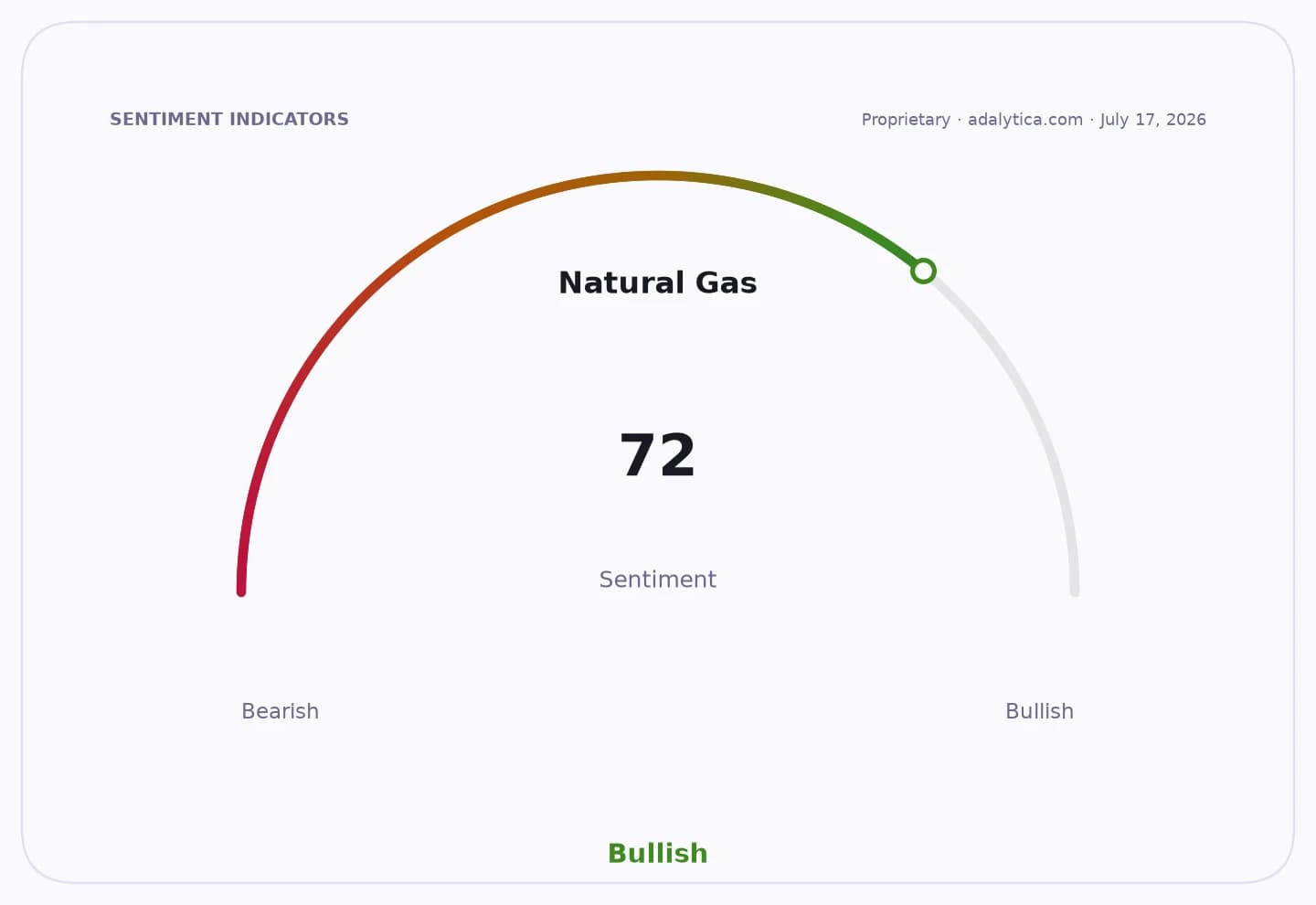
Sentiment IndicatorsⓘProprietary · adalytica.com · July 17, 2026
This is a snapshot — live sentiment, awareness and momentum for 130+ markets update continuously in the dashboard.Open AlphaPulse
That matters because the economic spillovers are bigger than many investors appreciate. More LNG exports mean more upstream drilling, more midstream throughput, more Gulf Coast construction and more industrial activity tied to the buildout of liquefaction capacity. S&P’s $1.4 trillion GDP figure implies a steady stream of investment and employment that extends well beyond the energy patch, reinforcing a broader reindustrialization narrative in the US.
Recent market action suggests investors are beginning to price that in, but not fully. Cheniere Energy, one of the clearest pure-play beneficiaries, has surged far above its 50-day and 200-day moving averages, with conventional technical indicators showing the stock in extended territory after a sharp rally. Kinder Morgan, a key natural gas transportation name, has also held near its long-term trend, reflecting the market’s growing recognition that export demand can support volumes across the midstream chain. The bigger point is that the value is not only in the molecules exported — it is in the infrastructure that makes those exports possible.
Geopolitics is accelerating the thesis. Supply disruptions, rerouted cargoes and tensions across key shipping lanes are reminding policymakers and buyers that energy security is now a strategic priority. Qatar’s position as a dominant LNG supplier is no longer untouchable, and the first direct US LNG shipment to China since the tariff fight underscores how trade flows can normalize quickly when supply reliability matters more than politics. Turkey’s expansion of LNG storage capacity and new projects elsewhere show the same thing: the world is still adding gas infrastructure, not backing away from it.
For investors, that creates a clear map of winners. The obvious beneficiaries are US LNG exporters, pipeline operators, terminal owners and engineering firms tied to capacity expansion. The less obvious winners are industrial suppliers, turbine makers, compressors, electrical equipment vendors and service companies exposed to the capex cycle. The losers are higher-cost exporters, countries dependent on unstable import routes, and any short thesis built on the idea that LNG is a transitional afterthought rather than a strategic asset.
Natural gas itself remains the key macro lever. With Adalytica’s natural gas trade signals showing elevated greed while global stability sentiment remains in fear territory, the setup still favors producers and infrastructure owners over anyone betting on a quick normalization in supply or geopolitics. The dollar’s recent churn and oil’s volatility only reinforce the case for gas-linked assets as a more durable way to express the energy-security trade.
The investment takeaway is straightforward: LNG is not just a commodity theme, it is a multi-decade infrastructure and geopolitics theme, and the market is still underpricing the full earnings power of the US export buildout. I believe investors should stay positioned in US LNG exporters, midstream gas transporters and the picks-and-shovels names supplying the liquefaction boom before the next leg of capacity growth turns today’s thesis into consensus.
| Entity | Gains | Losses |
|---|---|---|
| Cheniere Energy | ▲export volumes and pricing power | ▼capacity scarcity narrows |
| Kinder Morgan | ▲pipeline throughput and contract visibility | ▼low-volume gas market |
| U.S. industrials/suppliers | ▲LNG capex demand | ▼underinvested rivals |
| Qatar and other exporters | ▲none | ▼market share pressure |




