US retail sales climbed more than expected in September, but the headline gain was flattered by higher gasoline prices, leaving the underlying consumer picture more subdued than the top-line number suggests.
US retail sales rose 0.8% in September
The Commerce Department said retail sales rose 0.8% last month after an upwardly revised 1.3% increase in August, well above economists’ forecast for a 0.3% gain. But most of the rise came from gasoline, after pump prices jumped 7.1% in September, highlighting how energy inflation can mechanically boost nominal spending even when households are not buying much more in real terms.
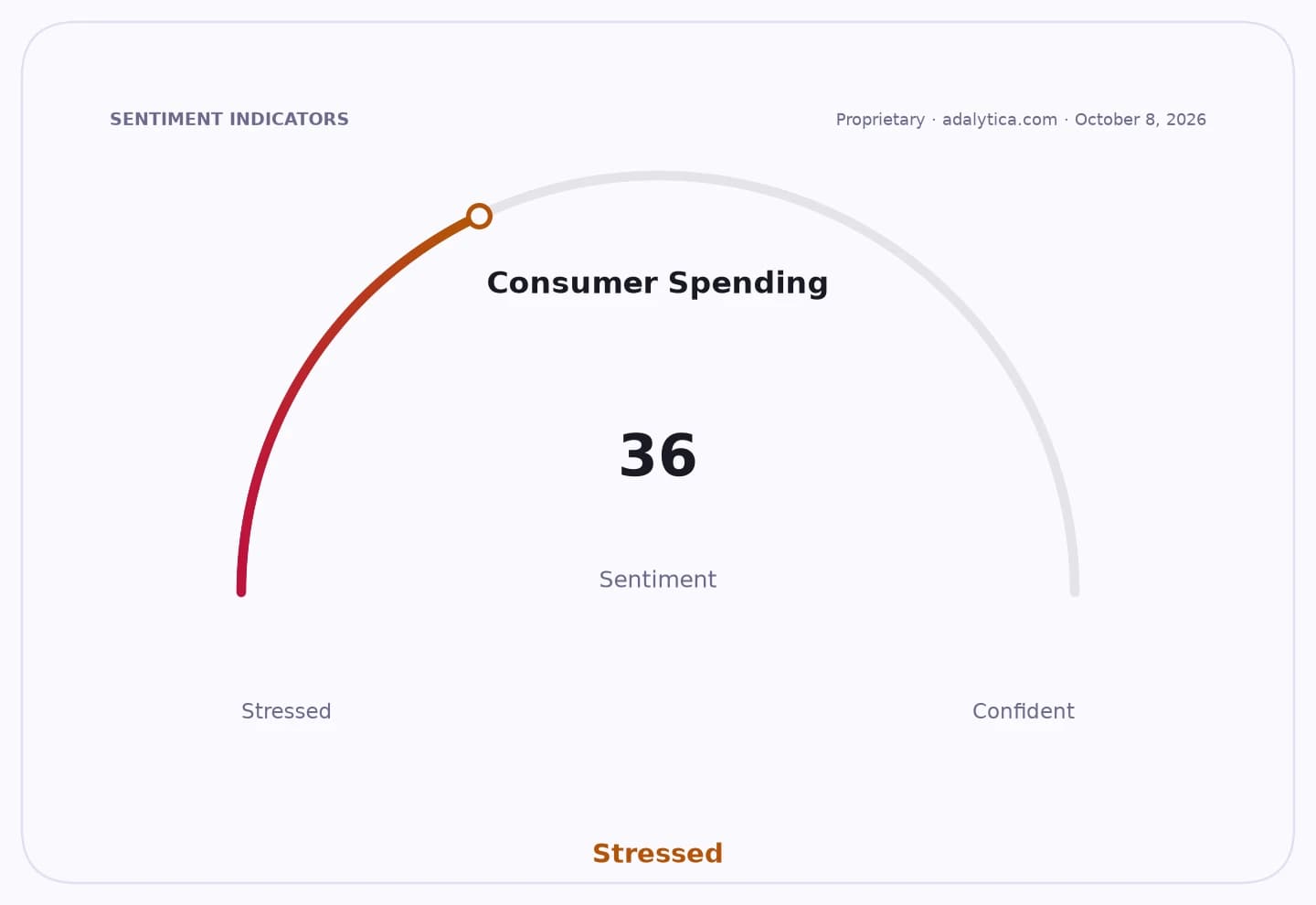
Sentiment IndicatorsⓘProprietary · adalytica.com · October 17, 2026
This is a snapshot — live sentiment, awareness and momentum for 130+ markets update continuously in the dashboard.Open AlphaPulse
That distinction matters for the economy because retail sales are among the best timely gauges of consumer demand, which accounts for roughly two-thirds of US economic activity. When gasoline is stripped out, along with autos, building materials and food services, so-called core retail sales rose only 0.1%, below expectations and after a 1.2% surge in August. That suggests consumer momentum entering the fourth quarter was not as strong as the headline figure implies.
The report also fits a broader pattern of uneven spending. Inflation-adjusted wages fell again in September, and the Federal Reserve’s Beige Book said most districts saw little change in overall consumer spending, with some lower-income households becoming more cautious. Bank of America said buy-now-pay-later usage picked up, though not yet at a level it called alarming, underscoring the strain on budget-conscious shoppers.
For investors, the data cuts both ways. It reduces the case for an abrupt slowdown in the near-term economy, which is supportive for cyclical assets, but it also reinforces the idea that consumer strength is being carried disproportionately by higher-income households and by nominal price gains rather than broad-based volume growth. That dynamic is consistent with the market’s recent favoring of energy shares, as oil and fuel prices rose sharply and helped lift the energy sector, while retailers and consumer-discretionary stocks remain more sensitive to whether demand can hold up beyond inflation.
The report leaves economists still expecting solid third-quarter consumer spending, around a 3.4% annualized pace by some estimates, but it also raises questions about sustainability. If gasoline prices stay elevated, they will continue to pad retail sales while squeezing discretionary budgets elsewhere. The next tests will be whether core spending rebounds in October and whether households can absorb higher fuel costs without further curbing nonessential purchases.
| Entity | Gains | Losses |
|---|---|---|
| Energy producers | ▲Higher revenue from fuel prices | ▼Demand risk if prices stay elevated |
| US retailers | ▲Nominal sales support from gasoline inflation | ▼Softer underlying traffic and baskets |
| Lower-income households | ▲None | ▼Biggest hit from higher fuel costs |
| Energy stocks | ▲Stronger investor flows | ▼Consumer cyclicals under pressure |