Washington’s public rift with Kyiv deepened after U.S. Treasury Secretary Scott Bessent said President Volodymyr Zelensky should be “very careful” about alleging that the Trump administration had moved to curb Starlink access or interrupt intelligence sharing.
U.S.-Ukraine Rift Deepens Over Starlink and Intelligence
The exchange matters because Ukraine’s battlefield position depends heavily on U.S. intelligence, communications and weapons access. Any hint that those flows could be slowed has immediate military consequences and also feeds into investor concern about whether Western support for Kyiv is becoming more conditional under President Donald Trump.
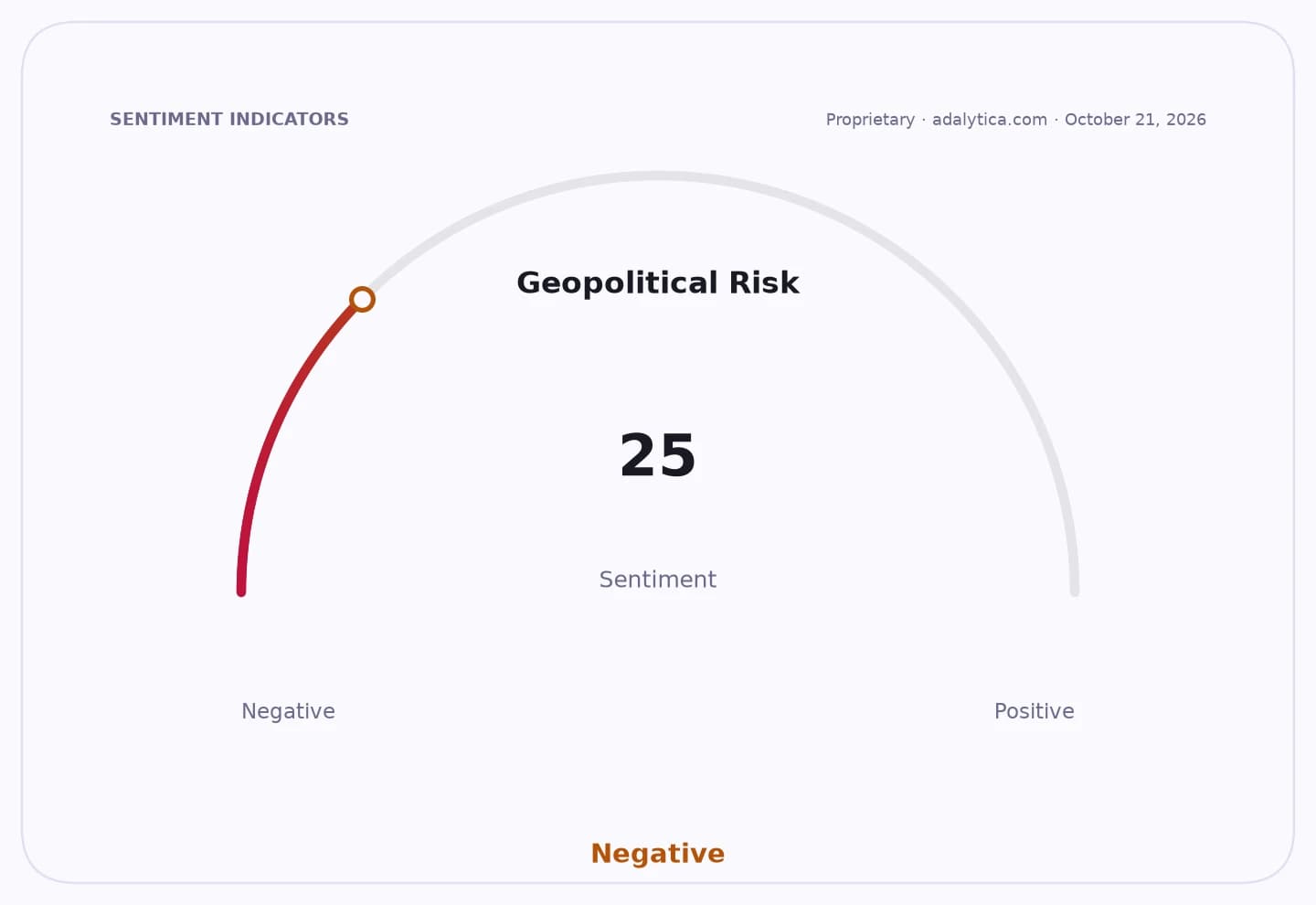
Sentiment IndicatorsⓘProprietary · adalytica.com · October 22, 2026
This is a snapshot — live sentiment, awareness and momentum for 130+ markets update continuously in the dashboard.Open AlphaPulse
Bessent pushed back strongly in an NBC News interview, calling Zelensky’s comments “very irresponsible” and saying Trump and Secretary of State Marco Rubio had said no one in the administration had ordered limits on Starlink. He also rejected the notion that Trump was siding with Moscow, saying that was a “false dichotomy.”
Even so, Bessent stopped short of explicitly saying the United States considers Ukraine an ally. Asked directly, he replied: “I’m not the president.” That ambiguity will reinforce market and geopolitical uncertainty at a moment when investors are already questioning the durability of U.S. backing for Kyiv.
The Treasury secretary framed the relationship in transactional terms, saying Washington still provides Ukraine with intelligence, Starlink connectivity and access for NATO countries to buy U.S. weapons and transfer them onward. Those are the tools of a wartime partner, he said, while Russia gets none of them.
For investors, the significance is less about the rhetoric than the policy signal it sends. The lack of a clean reaffirmation of alliance language, combined with Trump’s refusal to blame Putin and his resistance to Patriot transfers, suggests a more volatile support structure for Ukraine. That keeps pressure on Ukrainian sovereign debt, complicates the outlook for European defense spending and raises the geopolitical risk premium around the war.
The near-term question is whether Washington’s support remains intact in practice even as the language hardens. If intelligence sharing and satellite connectivity continue uninterrupted, markets may treat the spat as political theater. If not, the consequences for Ukraine’s defense, NATO coordination and risk assets tied to the war could be immediate.
| Entity | Gains | Losses |
|---|---|---|
| Russia | ▲Diplomatic leverage | ▼Western unity |
| Ukraine | ▲Continued U.S. support if preserved | ▼Credibility, bargaining position |
| Trump administration | ▲Pressure on Kyiv | ▼Alliance clarity |
| Defense contractors / NATO suppliers | ▲Higher demand for U.S. weapons | ▼Policy uncertainty |