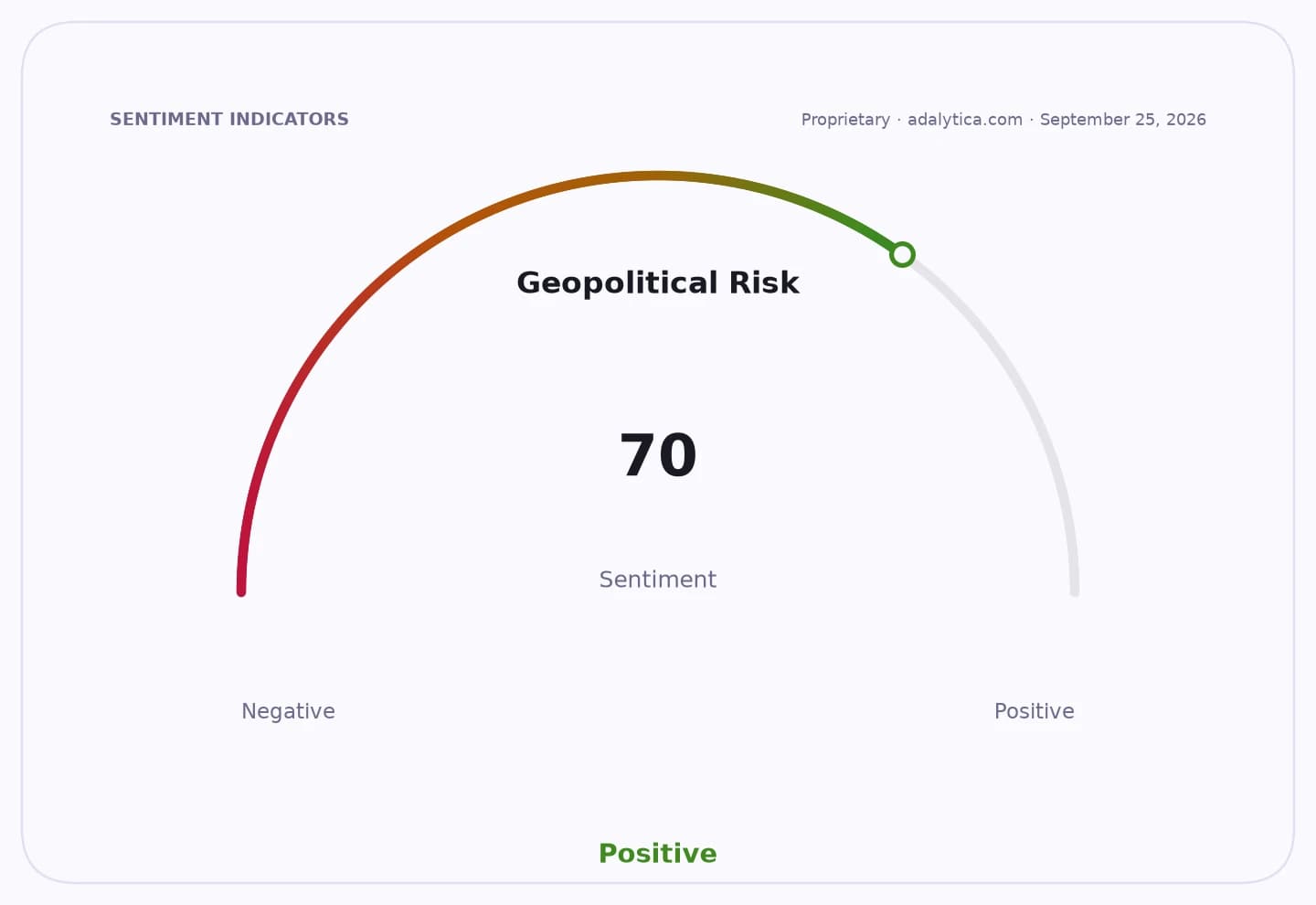
Power utilities are suddenly the market’s best answer to the AI buildout, and investors are starting to price in a multiyear surge in electricity demand that most of Wall Street still underestimates.
Utilities Benefit From AI Power Demand
That is the real story behind the sharp gains in utility names such as Duke Energy and NextEra Energy, alongside the sector ETF XLU, as data-center operators push grid capacity, transmission buildout and reliable baseload generation to the top of the investment agenda. The market is no longer treating electricity as a sleepy defensive: it is becoming a scarcity asset tied directly to the fastest-growing infrastructure cycle in tech.
Sentiment IndicatorsⓘProprietary · adalytica.com · July 17, 2026
This is a snapshot — live sentiment, awareness and momentum for 130+ markets update continuously in the dashboard.Open AlphaPulse
The economic significance is straightforward. Industrial production is holding above 102, showing the U.S. economy is not rolling over, while core inflation remains sticky at roughly 336 and the 10-year Treasury yield is still near 4.6%. That combination makes power infrastructure especially attractive: utilities offer regulated growth, inflation-linked returns and visible capital deployment at a time when many sectors face margin pressure from higher financing costs. In other words, the AI boom is colliding with an economy that rewards assets with pricing power and long-duration cash flows.
This is why the move in utilities matters far beyond a defensive rotation. XLU has climbed back above its 50-day and 200-day moving averages, with the latest reading near 45.47 versus a 50-day average of 44.71 and a 200-day average of 44.29. That kind of technical strength suggests institutional money is leaning into the theme, not just hiding in safety. The broader S&P 500, meanwhile, is flashing greed in Adalytica.com trade signals even as awareness remains low, a setup that often leaves the market vulnerable to missing slow-moving secular shifts like grid expansion.
Duke Energy and NextEra are among the clearest beneficiaries because they sit at the intersection of power demand, regulated rate bases and the need for new generation. Duke’s shares are trading around 126, above both its 50-day and 200-day moving averages, while NextEra has recovered from a spring selloff and is now back near 89, also above key long-term trend levels. Those are not just chart points; they reflect a market beginning to recognize that every new data center requires not only chips and servers, but wires, substations, permits, backup generation and years of utility capex.
Investors should see this as a second-order AI trade, and potentially a better one than chasing the hottest software names at stretched valuations. The market already knows data centers need semiconductors. It is only slowly waking up to the fact that they also need massive, recurring electricity infrastructure, which is harder to replicate, easier to regulate and far less exposed to product cycles. That makes utilities, grid equipment suppliers and independent power producers the picks-and-shovels winners of the AI era.
The policy backdrop reinforces the thesis. Across the U.S. and Europe, governments are being forced to confront rising electricity bills, grid congestion and the political cost of AI-driven power demand. That means more spending on transmission, more long-dated contracts, and likely more favorable treatment for companies that can bring capacity online quickly. For investors, the key is not to own the broad utility sector indiscriminately, but to focus on names with credible capital plans, exposure to fast-growing service territories and the ability to monetize load growth from data centers.
The trade is still early. As long as data-center expansion continues and rates stay elevated, utilities should keep attracting capital as a quasi-infrastructure growth theme rather than a bond proxy. For investors, the actionable takeaway is clear: buy the companies that sell the power, move the electrons and build the grid, because the AI boom is creating a structural demand shock that the market has not fully priced in yet.
| Entity | Gains | Losses |
|---|---|---|
| Duke Energy | ▲Data-center load growth | ▼Higher capex burden |
| NextEra Energy | ▲Utility growth premium | ▼Interest-rate sensitivity |
| XLU | ▲Defensive inflows | ▼Limited upside if theme fades |
| Large tech data-center operators | ▲More power access | ▼Higher electricity bills |