Onion prices in Uzbekistan’s Surxondaryo region have climbed even though harvest volumes are ample, because moving the crop from other provinces now adds enough cost to tighten margins and lift retail prices.
Uzbekistan onion prices rise on logistics costs
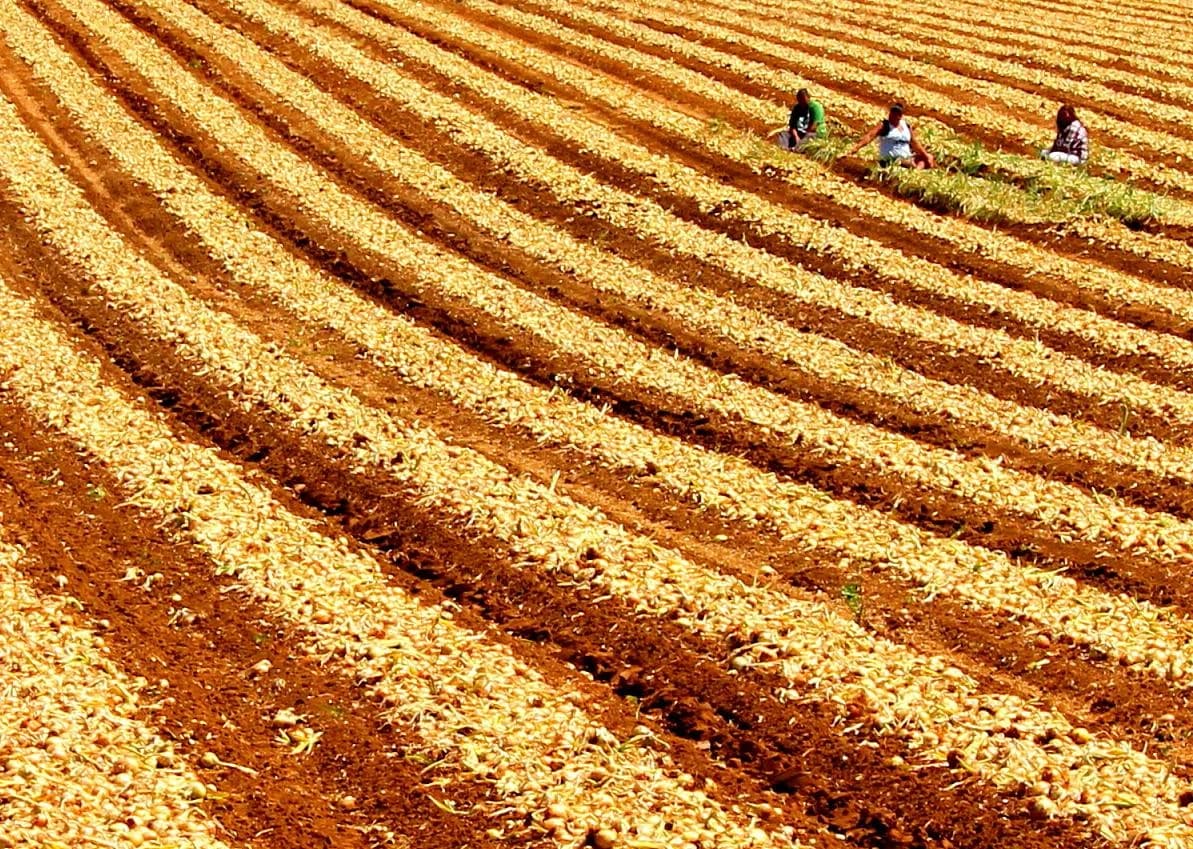
The Agriculture Ministry said the region’s local harvest is no longer in the fields, so traders are bringing onions in from Jizzakh and Samarkand to meet demand. That makes logistics a central driver of pricing: transporting one kilogram of onions costs 350 to 370 som, enough to materially widen the gap between farmgate and shop prices.
Sentiment Indicators
In Jizzakh, farmers are currently selling onions for 2,600 to 3,300 som a kilogram, while in Samarkand the range is 2,800 to 3,000 som. Once transport is added, delivered cost rises to 2,950 to 3,650 som from Jizzakh and 3,150 to 3,350 som from Samarkand. In Denau district, the delivered cost reaches 3,400 to 3,500 som. Retail prices in Surxondaryo markets are then settling around 4,000 to 4,500 som a kilogram.
The ministry’s calculations show how quickly the spread opens up. If onions are bought for 3,300 som and trucked in for 350 som, the delivered cost is 3,650 som; sold at 4,000 som, the margin is 9.6%. But if onions are bought for 2,600 som and sold at 4,500 som after transport, the spread jumps to 1,550 som, or 52.5% above cost. The ministry said intermediaries’ trading margins can reach 25% to 50%, reinforcing the view that distribution, not harvest scarcity, is helping keep prices elevated.
That matters economically because onions are a basic food item, so even modest increases feed directly into household spending and expectations for other staples. The ministry also said seasonal production patterns are part of the problem: Surxondaryo’s climate allows most onions to be harvested in April and May, while late-season plantings are limited by summer heat. In other words, the region’s supply base is sufficient on paper, but not evenly available across the year, forcing more expensive interregional flows.
The cost structure also shows how inflation can persist despite a decent agricultural year. The ministry said growing one hectare of onions in 2026 costs an average 65.5 million som, with labor and related payments accounting for 40.5% of that total. Mineral fertilizers and chemicals take 15.8 million som per hectare, while seeds and seedlings absorb 9.6 million som. At a national level, onion output is projected at 1.5 million tonnes in 2026, about 400,000 tonnes above medical consumption norms, which suggests the issue is less about national scarcity than about the friction cost of moving food to where demand is concentrated.
For investors and traders, the signal is straightforward: food-price pressure can emerge from logistics and storage economics even when supply is comfortable. That can matter for agribusiness, transport operators and fuel-sensitive sectors, while consumer inflation remains vulnerable to local bottlenecks. The ministry said 102,800 tonnes of onions are being set aside for the 2026-2027 winter-spring season, including 2,750 tonnes for Surxondaryo, and that stock releases and discounted sales through special outlets could help stabilize prices.
The near-term risk is that households rush to stockpile onions, lifting demand further, while traders hold back product in search of better margins. The ministry warned that long storage leads to weight loss and quality deterioration, limiting the case for withholding supply. For now, the key takeaway is that onion inflation in Surxondaryo is being driven less by poor harvests than by the cost of getting a sufficient crop to market.
| Entity | Gains | Losses |
|---|---|---|
| Interregional traders | ▲Wider retail margins | ▼Higher logistics costs |
| Consumers in Surxondaryo | ▲Access to supplied market | ▼Higher food bills |
| Jizzakh and Samarkand farmers | ▲Steady off-region demand | ▼Lower net realized price |
| Transport providers | ▲More haulage demand | ▼Fuel-cost pressure |