Victoria’s business case for restraint is collapsing into a fiscal warning for Premier Jacinta Allan, and the market cost of delay is rising fast.
Victoria debt outlook and market impact
New analysis ahead of the November election suggests the state’s net debt is on track to hit $200 billion within four years, deepening pressure on a budget already viewed as the most stretched in Australia. The message for investors is blunt: Victoria is heading toward a phase where higher interest costs, weaker flexibility and heavier tax pressure could combine to squeeze growth, crowd out spending and keep a lid on business confidence.
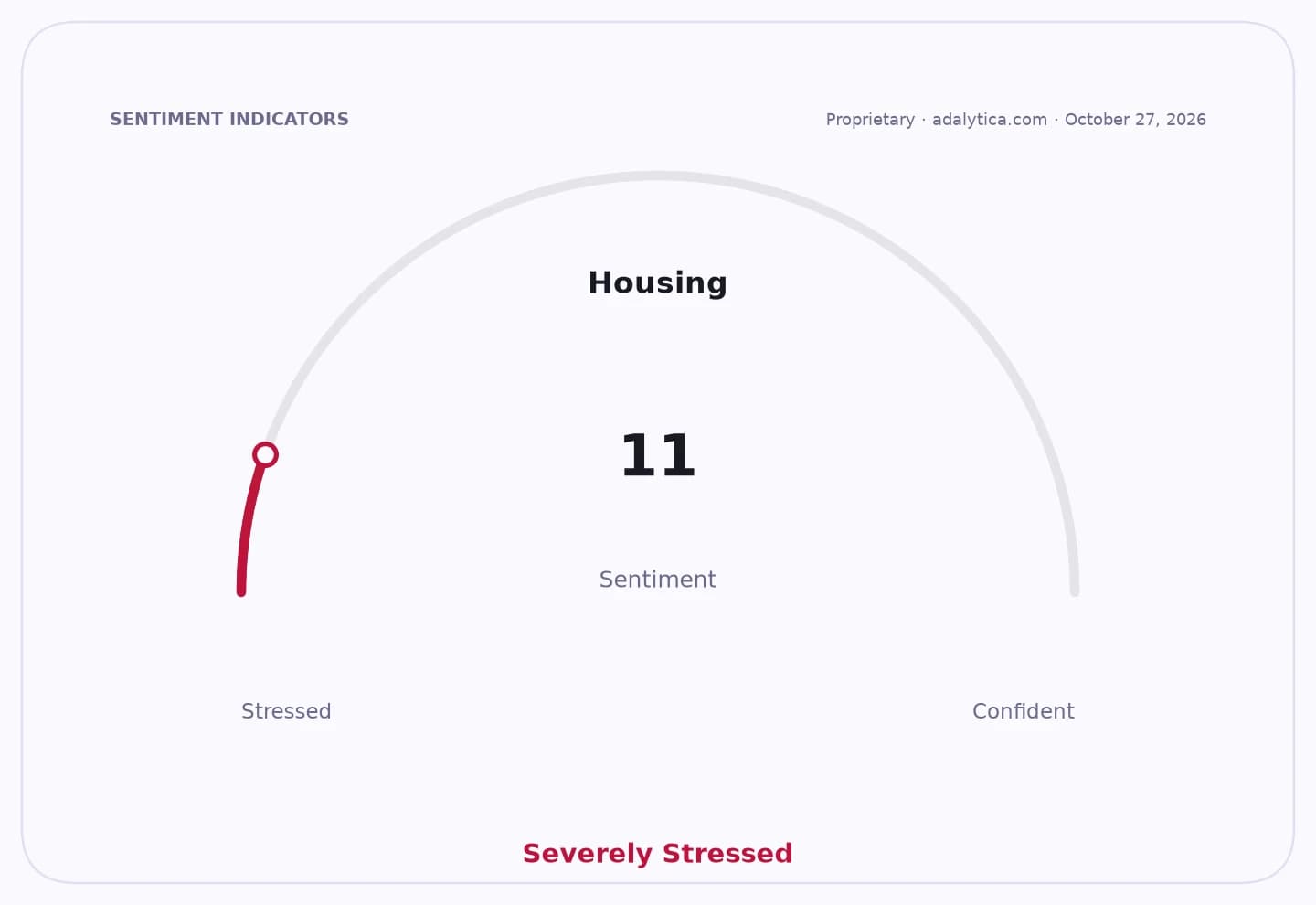
Sentiment IndicatorsⓘProprietary · adalytica.com · October 22, 2026
This is a snapshot — live sentiment, awareness and momentum for 130+ markets update continuously in the dashboard.Open AlphaPulse
That matters because debt servicing is becoming a bigger claim on public revenue just as the state’s economy is trying to absorb slower growth and still-firm borrowing costs. When a government is forced to devote more of its budget to financing existing obligations, it has less room to fund transport, hospitals and housing without either cutting elsewhere or asking the private sector to contribute more through charges and taxes. Either way, the multiplier is negative for domestic demand.
The political timing is awkward. The November election will now be fought against a backdrop of a widening structural gap, with the state’s fiscal trajectory increasingly visible to voters, ratings agencies and bond investors. The broader backdrop is hardly helpful: Australia’s borrowing costs remain elevated, and the benchmark 10-year U.S. Treasury yield has climbed back above 5%, a reminder that global funding conditions are not easing. In credit markets, high-yield spreads have also edged wider, underscoring that investors are still demanding compensation for balance-sheet risk.
For equity investors, the main implication is not just weaker sentiment around Victoria, but a broader reassessment of state-linked winners and losers. Contractors, infrastructure suppliers and public service providers may still benefit from pipeline spending, but the market underestimates the chance that projects get delayed, scaled back or reprioritized as debt pressure intensifies. Utilities, transport operators and consumer-facing businesses in Victoria could also face a tougher operating backdrop if government spending becomes more selective.
The opportunity, in our view, is to position for the second-order effects rather than the headline politics. If Victoria is forced into genuine fiscal repair, capital will migrate toward businesses exposed to national demand, export markets and federal rather than state spending. The losers are easy to spot: businesses reliant on a loose Victorian fiscal stance. The winners are those tied to productivity, infrastructure efficiency and sectors that can grow without waiting for the state budget to open.
The market still treats this as a local political story. It is not. It is a test of how much debt a major Australian state can absorb before it starts to reshape growth, pricing power and investor returns. If the government cannot produce a credible repair plan, the bond market will do the disciplining for it — and equity investors should expect that pressure to show up well before the election.
| Entity | Gains | Losses |
|---|---|---|
| Victorian voters | ▲eventual fiscal discipline | ▼near-term spending promises |
| Bond investors | ▲higher risk premia | ▼fiscal credibility erosion |
| Contractors/infrastructure suppliers | ▲project visibility if budgets hold | ▼delays and cutbacks |
| Victorian businesses | ▲less tax uncertainty if repair succeeds | ▼weaker demand and tighter spending |