Visa posted a better-than-expected quarter and reinforced its long-term cash-generating power, but the stock’s muted reaction shows investors are still focused on what happens next: slower consumer spending, tougher comparisons and whether payments growth can justify the premium multiple.
Visa Beat Meets Valuation Skepticism
That disconnect matters because Visa remains one of the market’s highest-quality financial franchises, yet the shares have been under pressure even as the company continues to deliver strong operating leverage and returns cash to shareholders. On July 28, Visa declared a quarterly dividend of $0.670 a share, underscoring the durability of its balance sheet and free cash flow generation, but the market is treating that as a given rather than a reason to re-rate the stock.
Sentiment IndicatorsⓘProprietary · adalytica.com · July 28, 2026
This is a snapshot — live sentiment, awareness and momentum for 130+ markets update continuously in the dashboard.Open AlphaPulse
The bigger question is whether the latest quarter marks a genuine inflection or just a brief reset after a powerful run. Visa’s shares finished July 28 at $366.59, only modestly above recent levels, after a sharp move earlier this month took the stock to $362.13 and pushed its 14-day RSI into overbought territory. The retreat and subsequent stabilization suggest investors have been reluctant to chase the name higher, even as the price sits above both the 50-day and 200-day moving averages, a sign the longer trend remains constructive.
For investors, the issue is not quality but expectations. Visa benefits from a structurally resilient business model tied to global electronic payments, and the company still has room to expand margins through efficiency gains. The reported effort to cut about 2,600 jobs, or 7% of its workforce, fits that logic: management is signaling that artificial intelligence and automation can support growth without proportional headcount increases. That is the kind of operating discipline investors usually reward.
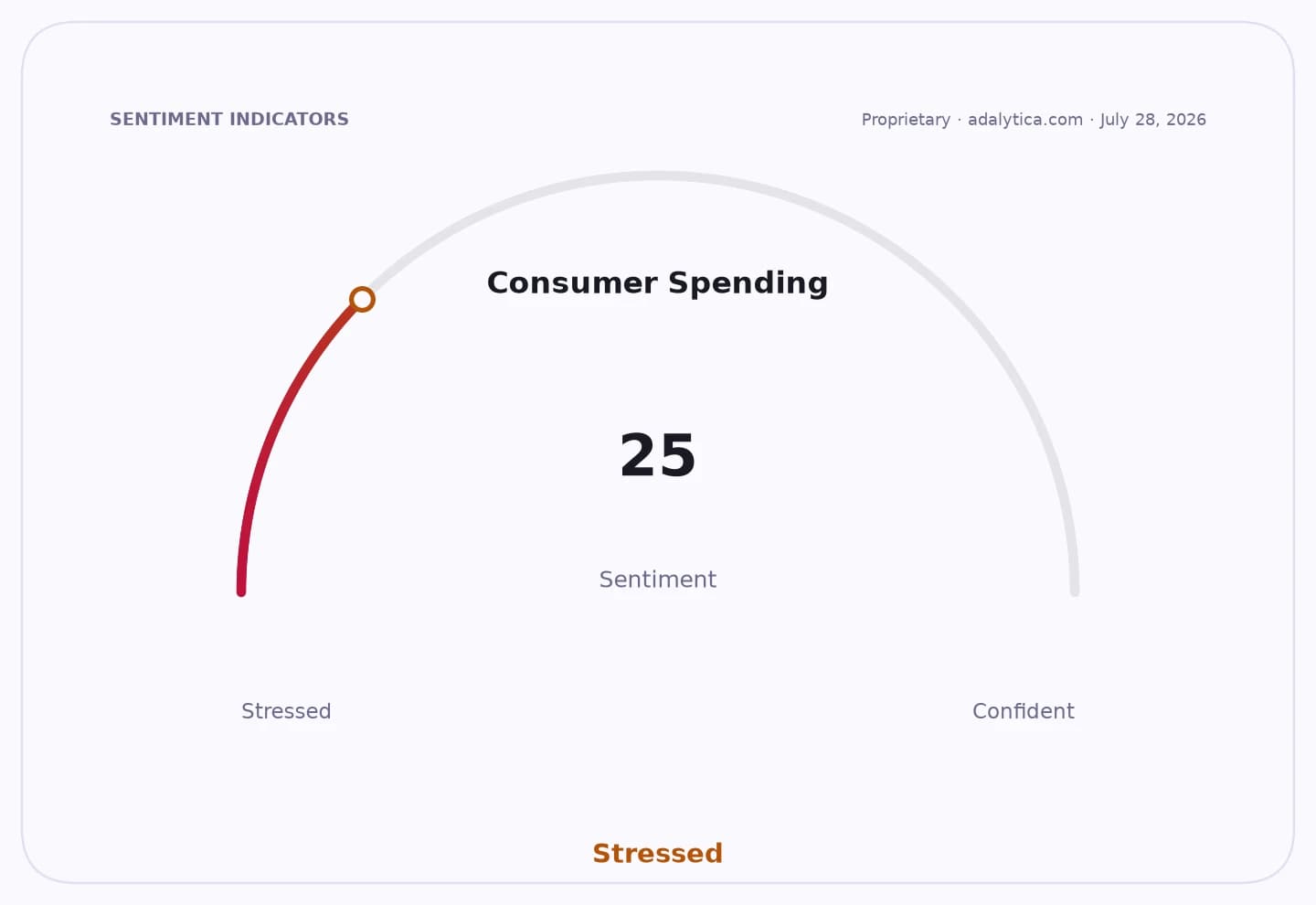
But the bear case is harder to dismiss now. Consumer spending sentiment, tracked by Adalytica, has fallen into fear territory, while awareness of spending trends has slumped to extreme fear. If that mood translates into weaker discretionary transactions, Visa’s volume growth could cool just as the market is demanding proof that the next leg of earnings growth can come from more than price increases and cost control. Mastercard’s shares have held up better, and PayPal’s recovery has been much more dramatic, highlighting that investors are still sorting winners from laggards in payments.
The stock’s technical backdrop also points to caution after the earnings lift. Visa’s 14-day RSI has climbed to 67.2, close to overbought levels, after a strong rebound from the spring selloff. That suggests the market may need another catalyst — such as sustained cross-border travel spending, stronger U.S. consumer volumes or clearer evidence that AI-led efficiency can support margin expansion — before investors are willing to push the multiple higher.
For now, Visa’s quarter supports the bull thesis that the franchise remains one of the safest growth stories in large-cap finance. But the lukewarm share reaction says the market is already looking past the current beat and asking whether the company can keep compounding in a slower consumer environment without relying on valuation support.
| Entity | Gains | Losses |
|---|---|---|
| Visa shareholders | ▲Dividend durability | ▼Immediate multiple expansion |
| Visa management | ▲Efficiency narrative | ▼Pressure to prove growth |
| Consumers | ▲Convenience in payments | ▼Less upside if spending slows |
| Competitors | ▲Opportunity to gain share | ▼Visa’s stronger operating model |