Webull’s decision to make a “smart money” bond strategy available for as little as $500 matters because it pushes one of the market’s oldest asset classes into the same low-friction, app-based world that drew millions of investors into stocks and ETFs. In a year when bond markets have been swinging on fiscal worries, rate uncertainty and rising volatility, cheaper access to fixed income could reshape how retail investors build portfolios — and how brokerages compete for sticky assets.
Webull’s Bond Push Targets Retail Cash
The big economic story here is not just a new product. It’s the continuing democratization of fixed income at a time when yields are attracting renewed attention. When bonds are volatile, money market and Treasury exposure stops being a niche defensive move and becomes a core portfolio decision. Webull is betting that younger, digitally native investors want more than trading tools; they want a place to park cash, earn income and manage risk without needing the six-figure minimums that once kept institutional-style bond strategies out of reach.
Sentiment IndicatorsⓘProprietary · adalytica.com · July 27, 2026
This is a snapshot — live sentiment, awareness and momentum for 130+ markets update continuously in the dashboard.Open AlphaPulse
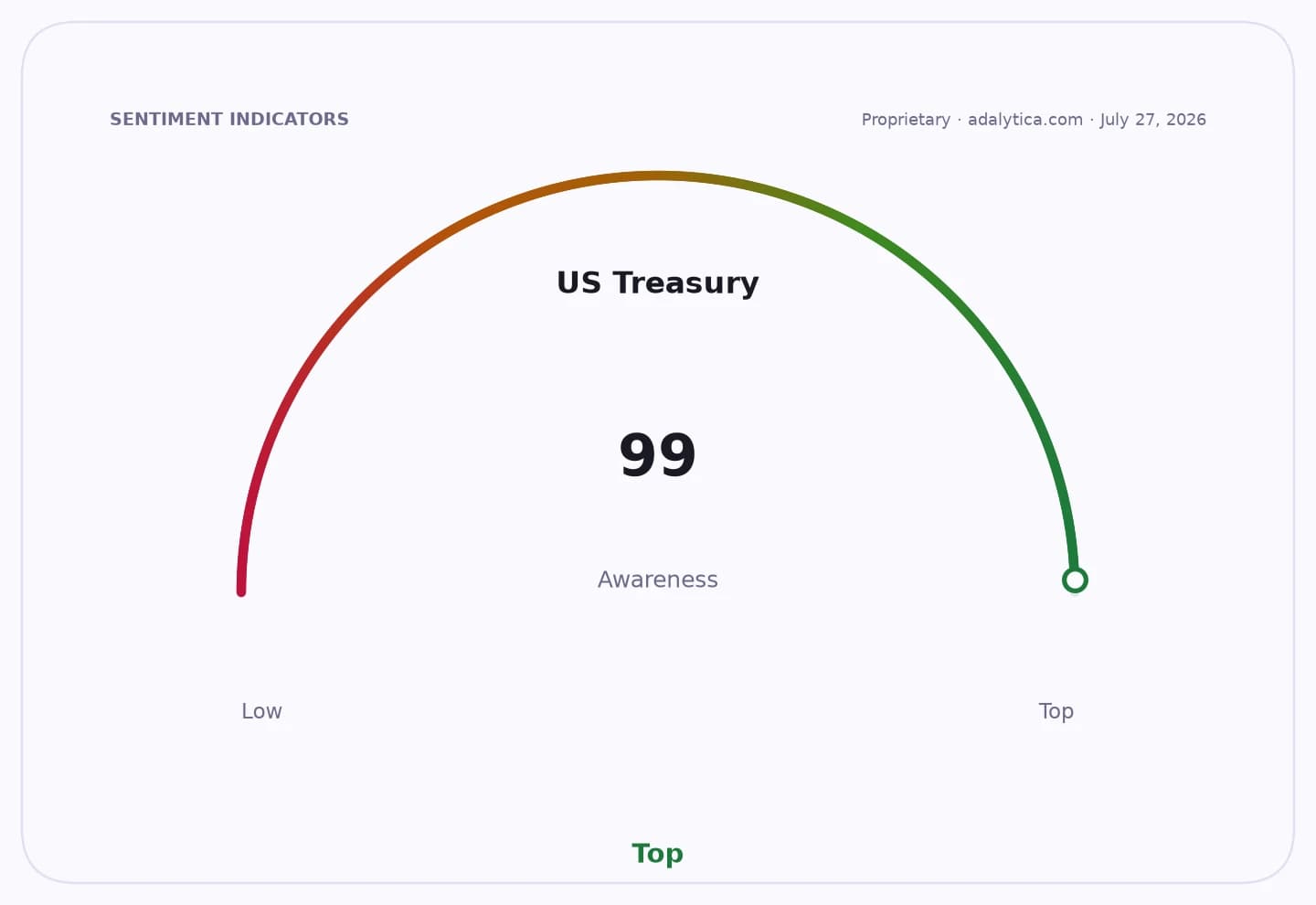
That fits a broader shift in the market. Treasury sentiment remains cautious even as awareness of the sector is high, reflecting how quickly investors have turned from chasing growth to looking for ballast. The backdrop is messy: sharp yield moves, heavier government borrowing and fresh supply around the world have kept bond traders on edge. In that environment, a platform that can package bond exposure in a simple, low-minimum format has a chance to win assets from customers who would otherwise leave idle cash sitting on the sidelines.
For Webull, the move is also a strategic swing at bigger rivals. Interactive Brokers and Charles Schwab already use brokerage sweep balances, bond access and cash-management features to deepen client relationships, but Webull’s edge is distribution to smaller accounts and newer investors. A $500 entry point lowers the psychological barrier as much as the financial one, which is exactly how fintech platforms build habits, retain users and increase assets under custody over time.
Investors should see this as part of a larger business model story. Brokerage firms do not become enduring winners by helping customers trade once; they win by becoming the default home for assets across market cycles. If Webull can turn first-time bond buyers into long-term users who also hold equities, ETFs and cash products, it strengthens the case for recurring revenue and higher lifetime value per customer. That is especially important in a market where trading activity can cool fast, but balances and interest-bearing assets compound more predictably.
There are risks. Bond demand can fade if yields move higher or if customers find the product confusing. Webull also has to prove that it can monetize these investors without alienating them, especially in a space where trust matters and pricing transparency is under the microscope. Still, for long-term investors, the larger takeaway is encouraging: the fight for the retail balance sheet is moving beyond stock trading and into fixed income.
If Webull can make bond investing feel as simple as buying a stock, that could be a meaningful competitive advantage. It is worth watching as a sign that the next phase of online brokerage growth may come less from frenetic trading and more from helping everyday investors build sturdier, income-producing portfolios for the long haul.
| Entity | Gains | Losses |
|---|---|---|
| Webull | ▲More assets, stickier users | ▼Lower-margin one-off traders |
| Retail investors | ▲Cheaper bond access | ▼Old minimum barriers |
| Schwab, IBKR | ▲Higher industry demand for bond access | ▼Pressure to match pricing |
| Cash hoarders | ▲Income option | ▼Idle cash returns |




