The dollar’s grip near the high 163-yen range shows how little the market believes policy makers can do, right now, to break Japan’s currency slump.
Yen Weakness Keeps Pressure on Japan and BOJ

That matters because a weak yen is no longer just a foreign-exchange story. It is a direct transmission channel into Japan’s inflation, import costs, trade balance and corporate earnings, while also shaping the next move in global capital flows. With the Federal Reserve and Bank of Japan meeting in the same week, traders are effectively betting that neither central bank will deliver the kind of surprise that forces a lasting reset in USD/JPY.
Sentiment IndicatorsⓘProprietary · adalytica.com · July 28, 2026
This is a snapshot — live sentiment, awareness and momentum for 130+ markets update continuously in the dashboard.Open AlphaPulse

The yen’s brief recovery has been too modest to change the larger picture. It remains pinned near a four-decade low, a level that has become politically and economically dangerous for Tokyo. Higher oil prices tied to Middle East tensions have compounded the pressure by lifting Japan’s import bill just as the weak currency makes every shipment of energy and food more expensive. That combination is worsening inflation without producing the kind of wage-led demand Japan wants to see, while also widening the trade deficit.
For investors, the most important message is that the market underestimates how persistent this regime can be. The yen is not simply weak because of a temporary risk-off move; it is weak because the interest-rate gap with the U.S. remains punishingly wide and because intervention has had only limited credibility. That is why the dollar can hover in the 163 area even as authorities talk tough. In Adalytica’s trade signals, the U.S. dollar shows extreme fear even after a sharp drop in sentiment, while the yen’s own signals point to fear rather than confidence — a combination that suggests positioning is stretched but not yet broken.
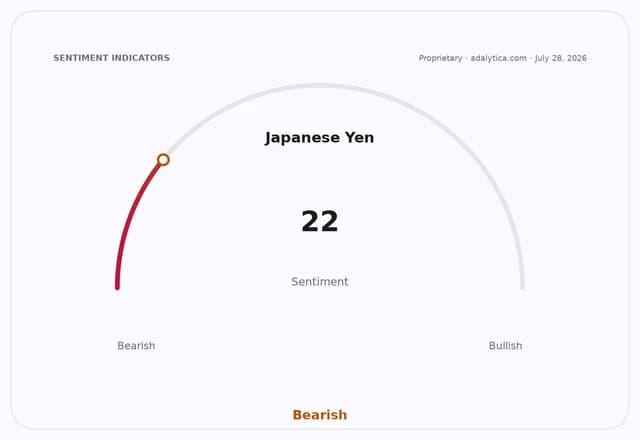
That has real investment consequences. Exporters with dollar revenues can continue to benefit from translation tailwinds, but the market should be more cautious on Japanese importers, utilities and consumer names facing higher input costs. The deeper opportunity, in our view, sits in understanding the second-order effects: if the yen stays weak, Japan’s inflation problem stays alive, which keeps pressure on the Bank of Japan to normalize policy more carefully and could eventually support a stronger domestic-rate narrative. If the BOJ moves too slowly, the market keeps punishing the currency; if it moves too fast, Japanese equities tied to domestic demand may wobble.
The technical picture in yen-linked exchange-traded exposure has also turned fragile. The iShares MSCI Japan ETF proxy, FXY, is trading below both its 50-day and 200-day moving averages, with RSI readings still subdued and MACD negative, a conventional technical setup that fits a market lacking conviction rather than one preparing for a durable reversal. That is consistent with the broader story: traders are waiting for central banks, but the underlying macro asymmetry still favors volatility over resolution.
The next catalyst is not whether the yen can bounce a few figures from here. It is whether policy makers can finally narrow the credibility gap. Until they do, the market will keep treating 160-plus yen as a warning sign rather than a floor — and that creates a powerful, if uncomfortable, thesis for investors: stay selective on Japan, favor exporters and hedged global revenue streams, and don’t assume the currency regime is about to normalize on its own.
| Entity | Gains | Losses |
|---|---|---|
| Japanese exporters | ▲FX translation tailwind | ▼Lower imported-input costs fade |
| Japanese importers | ▲— | ▼Higher energy and food bills |
| BOJ hawks | ▲Policy pressure rises | ▼Credibility if yen keeps sliding |
| USD bulls | ▲Wide rate gap persists | ▼Risk of sharp intervention-driven reversal |




